WeChat: 18966915318
Phone: +86 18966915318
E-mail: sales05@nutritionoem.com
Add: Room 815, Unit 1, Building 1, Zhongjian Caizhi Plaza, Mingguang Road, Yuanding Road, Economic And Technological Development Zone, Xi'an, Shaanxi, China
Phone: +86 18966915318
E-mail: sales05@nutritionoem.com
Add: Room 815, Unit 1, Building 1, Zhongjian Caizhi Plaza, Mingguang Road, Yuanding Road, Economic And Technological Development Zone, Xi'an, Shaanxi, China
Does epicatechin really build muscle?
Time: 2026-05-30 Source: Author:
What is epicatechin?
- Epicatechin belongs to the flavanol class of compounds and is primarily derived from everyday foods such as dark chocolate, apples, green tea, and berries.
- Unlike many plant compounds that remain theoretical, epicatechin is unique in that it possesses biological activity—meaning it can trigger measurable physiological changes in the body, rather than simply existing as an antioxidant.

The Core Mechanisms of Epicatechin in Muscle Building
1. Inhibition of Myostatin
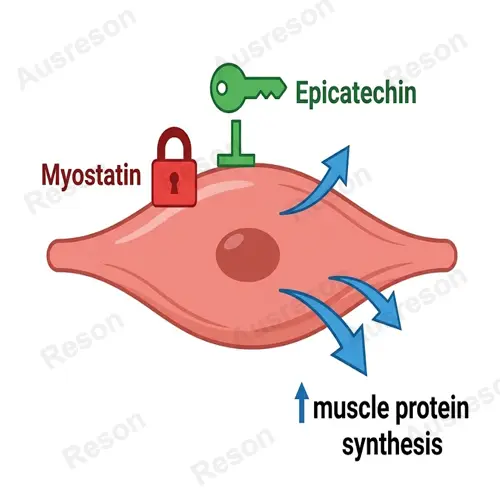
- Myostatin is a protein that limits excessive muscle growth. You can think of it as the "brake" on muscle development. Epicatechin exhibits a key ability: downregulating the expression of myostatin.
- By naturally "releasing the brake," epicatechin creates a more favorable environment for muscle growth. This is particularly beneficial for individuals whose myostatin levels rise with age or due to illness.
2. Activation of the Muscle-Specific Signaling Pathway (AKT/mTOR)
- Simply removing the restriction is not enough; the body also needs signals to actively build muscle. Studies have shown that epicatechin can stimulate the AKT/mTOR signaling pathway.
- This is the core switch for muscle protein synthesis. When this pathway is activated, your body utilizes dietary amino acids more efficiently to build new muscle tissue.
3. Enhances Mitochondrial Biosynthesis
- Epicatechin can also promote mitochondrial biosynthesis by activating pathways such as AMPK. Mitochondria are the cell's "powerhouses," and more mitochondria mean greater endurance and better recovery. This explains why this compound not only increases muscle size but also improves muscle performance.
How effective is it in humans?
This is the most crucial question: can its effects in vitro and in animals translate to real humans?
The answer is multifaceted, but overall positive.
- A clinical trial investigating the effects of epicatechin on patients with chronic kidney disease—a condition often accompanied by muscle atrophy and myofibril degeneration—is exploring the potential of epicatechin. In this trial, participants took 100 mg of epicatechin daily for eight weeks.
- Researchers are using sophisticated tools such as MRI and ultrasound to measure changes in muscle mass. While final data are still being collected, the underlying theory is that through the dual effects of epicatechin on myostatin and mitochondria, we should be able to observe an increase in muscle mass.
Prev: Epicatechin vs. myostatin blockersNext: Back to List