Phone: +86 18966915318
E-mail: sales05@nutritionoem.com
Add: Room 815, Unit 1, Building 1, Zhongjian Caizhi Plaza, Mingguang Road, Yuanding Road, Economic And Technological Development Zone, Xi'an, Shaanxi, China
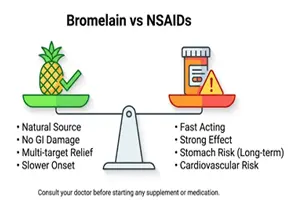
bromelain vs NSAIDs for inflammation
What are Nonsteroidal Anti-inflammatory Drugs (NSAIDs)? How do they work?
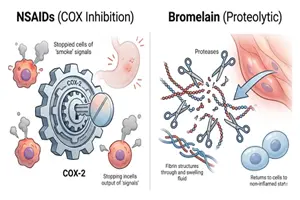
NSAIDs (such as ibuprofen, naproxen, and diclofenac) are among the most commonly used medications worldwide. They work by inhibiting cyclooxygenase in the body.
Simply put, cyclooxygenase is a key enzyme in the production of prostaglandins, chemicals that cause pain, swelling, and fever. By blocking cyclooxygenase, NSAIDs effectively reduce prostaglandin synthesis, thus quickly relieving inflammatory symptoms.
Common Side Effects and Risks of NSAIDs
Although NSAIDs are highly effective, their side effects should not be underestimated, especially with long-term or high-dose use. Google's EEAT standards emphasize the professionalism of content, and we must acknowledge these risks:
- Gastrointestinal damage: This is the most common side effect. Because prostaglandins are also responsible for protecting the gastric mucosa, NSAIDs, while suppressing inflammation, can damage the stomach's protective barrier, leading to stomach discomfort, ulcers, and even bleeding.
- Cardiovascular risks: Long-term use of certain nonsteroidal anti-inflammatory drugs (NSAIDs), especially high doses of diclofenac and ibuprofen, can increase the risk of heart attack and stroke.
- Kidney burden: NSAIDs can affect blood flow to the kidneys, potentially leading to kidney damage or fluid retention.
What is Bromelain? A Natural Anti-inflammatory Choice
- Bromelain is a proteolytic enzyme extracted from the stem and fruit of the pineapple (Ananas comosus). It is not a single substance, but a complex of enzymes with a powerful protein-degrading ability.
- For centuries, bromelain has been used in folk remedies. It wasn't until the rise of modern medicine that scientists began to uncover the scientific principles behind it.
The Molecular Mechanism of Action of Bromelain
Unlike nonsteroidal anti-inflammatory drugs (NSAIDs), bromelain does not directly block cyclooxygenase. Its mechanism of action is more complex and "intelligent," primarily acting through the following pathways:
- Selective Regulation of Prostaglandins: Studies have shown that bromelain does not completely inhibit all prostaglandins. It appears to selectively inhibit the synthesis of "pro-inflammatory" prostaglandins without affecting those with "anti-inflammatory" protective effects. This helps restore the body's balance.
- Inhibition of Key Signaling Pathways: Modern research has found that bromelain can effectively inhibit two key inflammatory signaling pathways: nuclear factor κB and mitogen-activated protein kinase. By blocking these pathways, bromelain can reduce the production of pro-inflammatory factors such as tumor necrosis factor-α and interleukin-6.
- Reducing blood viscosity: Bromelain has fibrinolytic activity, which can break down excess fibrinogen in the blood. This not only improves blood circulation and reduces tissue edema, but also indirectly relieves pain by reducing blood viscosity.

| Comparison Dimension | Bromelain | NSAIDs (Non‑Steroidal Anti‑Inflammatory Drugs) |
|---|---|---|
| Mechanism of Action | Multi‑target: Inhibits the NF‑κB pathway, selectively regulates prostaglandins, breaks down fibrin proteins | Single‑target: Non‑selectively inhibits COX enzymes, blocking all prostaglandin synthesis |
| Onset Speed | Slow (requires time to regulate metabolism) but with long‑lasting effects | Rapid, usually effective within 30 minutes to several hours |
| Common Side Effects | Mild; occasional gastrointestinal discomfort or allergies in a small number of people | Significant: Gastrointestinal ulcers, bleeding, kidney damage, cardiovascular risks |
| Cardiovascular Safety | High. No increased risk of cardiovascular events | Low. Long‑term use increases the risk of heart attack and stroke |
| Best Use Cases | Long‑term management of chronic arthritis, post‑operative swelling reduction, sports injury recovery | Acute severe pain, short‑term control of severe symptoms (e.g., severe menstrual cramps) |