Phone: +86 18966915318
E-mail: sales05@nutritionoem.com
Add: Room 815, Unit 1, Building 1, Zhongjian Caizhi Plaza, Mingguang Road, Yuanding Road, Economic And Technological Development Zone, Xi'an, Shaanxi, China
trans-resveratrol vs. resveratrol
What is resveratrol?
Resveratrol is a natural polyphenol compound, first extracted from the roots of *Veratrum nigrum* by Japanese scientists in 1939. It is found in red wine, grape skins, blueberries, and *Polygonum cuspidatum* (a traditional Chinese medicine). It is a "self-defense system" substance secreted by plants in response to external stresses such as ultraviolet radiation, fungal infections, or diseases.
In human studies, resveratrol has been shown to possess powerful antioxidant properties, activate the longevity gene (SIRT1), protect the cardiovascular system, and improve insulin sensitivity.
Why You Must Choose "Trans" Resveratrol?
1. Decisive Bioavailability
According to research published in the *Journal of Agricultural and Food Chemistry*, cis resveratrol, once ingested, has difficulty binding to cell receptors and is easily metabolized and excreted by the liver. Trans resveratrol, on the other hand, has a perfect spatial configuration, allowing it to easily penetrate cell membranes and truly participate in the body's antioxidant cycle. Buying impure resveratrol means your body can't absorb it, essentially paying for a "concept."
2. The Deception of Raw Material Source and Purity
Common "resveratrol" is usually derived directly from grape skins or unpurified Polygonum cuspidatum extract. The total resveratrol content of this raw material may be only 50% or even lower, and it contains a large amount of emodin. Emodin is a component that easily causes diarrhea and gastrointestinal discomfort.
High-purity "trans-resveratrol": It usually undergoes multiple purification processes (purity is generally above 98% or 99%) to remove impurities such as emodin, ensuring that every milligram is a highly effective and safe active substance.
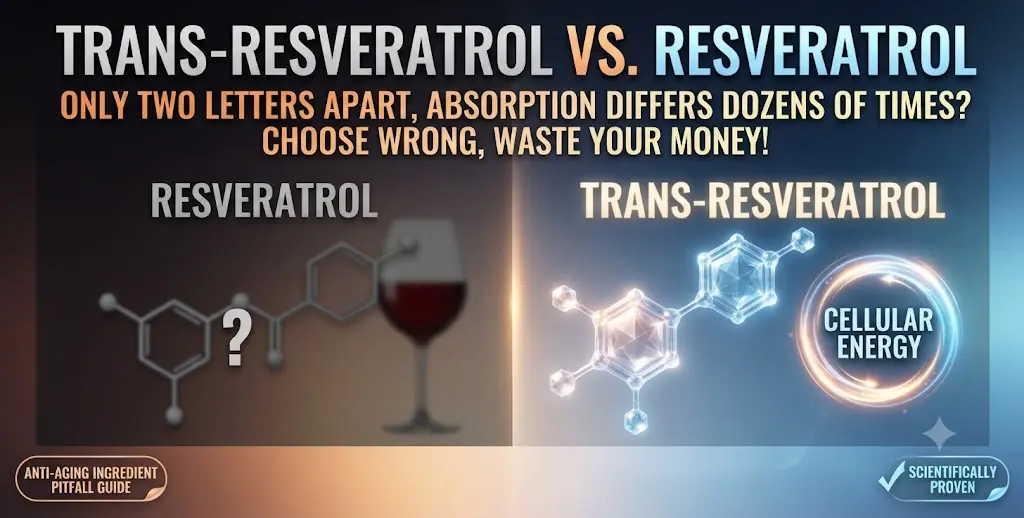
Core Differences: Cis vs. Trans Isomers
| Dimension | Trans-Resveratrol | Cis-Resveratrol |
|---|---|---|
| Spatial Structure | Molecular ends aligned in opposite directions (stable, extended conformation) | Molecular ends aligned in the same direction (unstable, bent conformation) |
| Biological Activity | Extremely high (the active compound used in the vast majority of scientific studies) | Extremely low (hardly any notable physiological activity) |
| Stability | Relatively stable against light and heat | Highly unstable, prone to degradation |
| Natural Occurrence | The dominant form found in fresh plants and high-quality extracts | A degradation product converted from trans-resveratrol upon light exposure or heating |
3 Golden Rules for Understanding Ingredient Lists
Rule 1: Check the chemical name for "Trans-"
Check the ingredient list (Supplement Facts) on the back of the bottle.
Incorrect Example: Resveratrol (from Polygonum cuspidatum) – This only states the source of resveratrol, not the percentage of active ingredients.
Correct Example: Polygonum cuspidatum root extract (Standardized to 98% Trans-Resveratrol) – Clearly states that it contains 98% standardized trans-resveratrol.
Rule 2: Check the source of the core raw materials
High-quality trans-resveratrol on the market mainly comes from two sources:
High-purity Polygonum cuspidatum extract: Extremely cost-effective. As long as it is purified to over 98% and emodin is removed, it is an ideal choice.
Fermentation/Synthesis: Produced through biotechnology such as yeast fermentation, naturally free of emodin, with extremely high purity, but usually more expensive.
Note: Resveratrol extracted solely from grapes or red wine is extremely expensive, and due to its low natural content, it's difficult to produce high-dose supplements. If a cheap product claims to be "purely grape-derived," be wary of its actual content.
Rule 3: Pay Attention to Synergistic Ingredients
Scientific research shows that trans-resveratrol, when combined with certain ingredients, can produce a synergistic effect greater than the sum of its parts (1+1>2). For example:
Trans-resveratrol + Quercetin: Quercetin can inhibit enzymes in the body that weaken the activity of resveratrol, prolonging its residence and working time in the body.
Trans-resveratrol + NMN: The two are an excellent "accelerator and gasoline" combination in the cellular anti-aging mechanism (SIRT longevity protein pathway).
Frequently Asked Questions (FAQ)
Q: Can drinking red wine supplement trans-resveratrol?
A: Almost impossible. A bottle of red wine typically contains only about 1mg to 5mg of trans-resveratrol. To reach the effective dose in clinical studies (such as 250mg), you would need to drink dozens or even hundreds of bottles of red wine daily, which would obviously cause devastating damage to the liver.
Q: Are there any side effects from taking high-purity trans-resveratrol?
A: At regular doses (below 500mg daily), high-purity trans-resveratrol is very safe. However, if the purity is low or it contains emodin impurities, it may cause stomach pain or diarrhea. Additionally, due to its mild anticoagulant effect, people planning surgery or taking anticoagulants (such as warfarin) should take it under the guidance of a doctor.
Disclaimer: This article is based on publicly available scientific literature and does not constitute any medical diagnosis or medication advice. Please consult a professional physician before starting any new dietary supplement.