Phone: +86 18966915318
E-mail: sales05@nutritionoem.com
Add: Room 815, Unit 1, Building 1, Zhongjian Caizhi Plaza, Mingguang Road, Yuanding Road, Economic And Technological Development Zone, Xi'an, Shaanxi, China
Why Liposomal Delivery Matters: NMN, NAD+, and Glutathione Absorption Explained
The Absorption Bottleneck in Conventional Oral Supplements
The human gastrointestinal (GI) tract is designed to break down organic compounds into their basic components. While efficient for digestion, this harsh environment degrades delicate bioactive molecules before they reach systemic circulation.
-
Stomach Acid & Enzymatic Degradation: Highly acidic gastric juice (pH 1.5–3.5) and digestive enzymes degrade fragile molecules, reducing their biological activity.
-
Intestinal Barrier Limitations: Water-soluble or large molecules struggle to pass through the hydrophobic lipid bilayer of intestinal epithelial cells via passive diffusion.
-
First-Pass Hepatic Metabolism: Nutrients absorbed through standard intestinal pathways travel directly via the portal vein to the liver, where hepatic enzymes metabolize a significant percentage of the active dose before it reaches peripheral tissues.
How Liposomal Delivery Technology Works
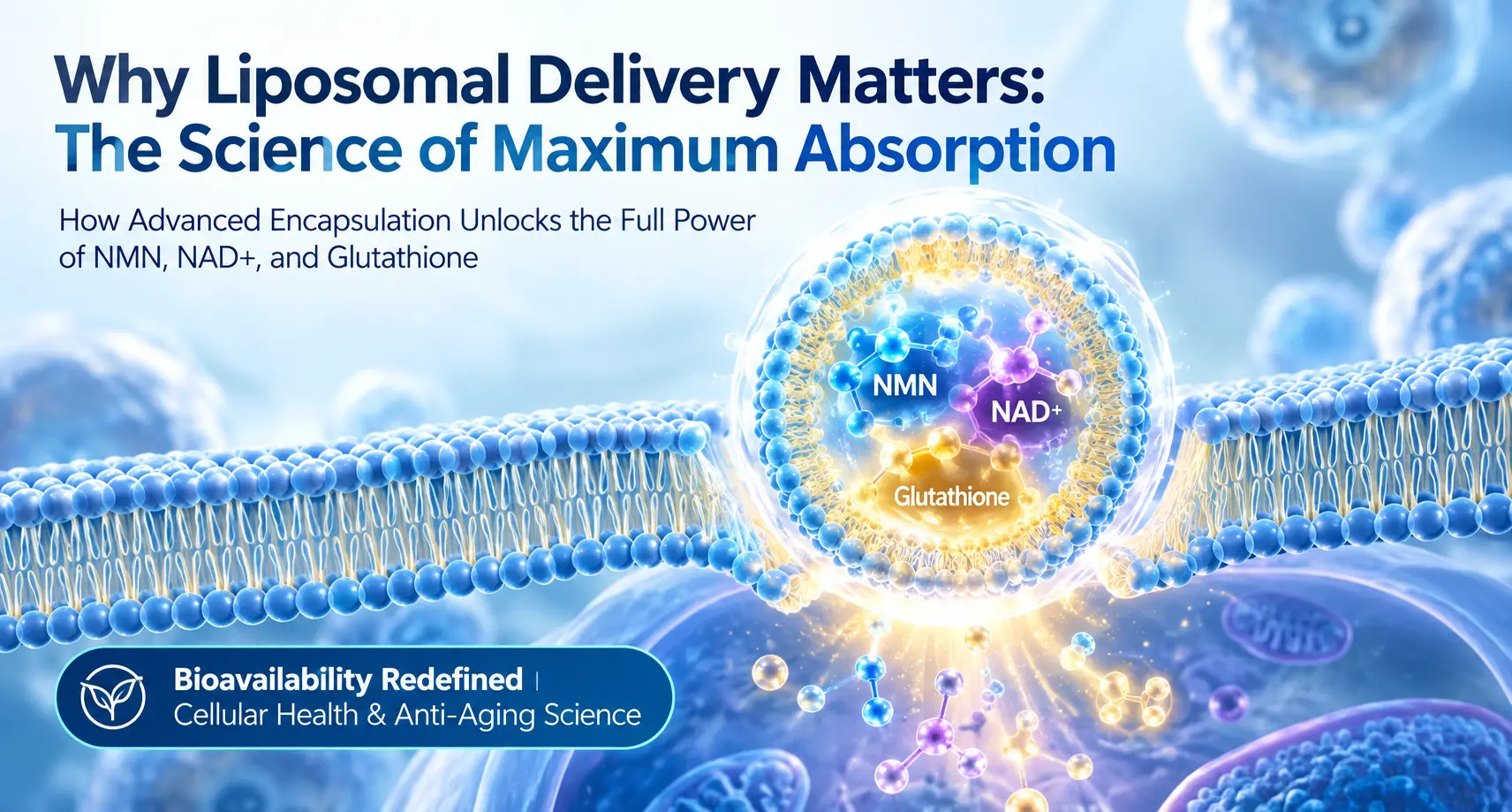
Liposomes are microscopic, spherical vesicles consisting of one or more phospholipid bilayers surrounding an aqueous core. Phospholipids—primarily phosphatidylcholine—are identical to the structural lipids that form human cell membranes.
+-----------------------------------------------------------------------+
|                         Liposomal Structure                           |
|                                                                       |
|      [ Hydrophilic Outer Head ]  ---> Interacts with watery fluids    |
|      [ Hydrophobic Inner Tail ]  ---> Creates protective lipid barrier|
|      [ Aqueous Core Interior  ]  ---> Holds hydrophilic active compounds|
+-----------------------------------------------------------------------+
Key Mechanisms of Enhanced Bioavailability
-
Protective Encapsulation: Active ingredients inside the inner core are shielded from enzymatic breakdown and stomach acid.
-
Cellular Membrane Fusion: Because liposomal membranes mirror human cell membranes, they can fuse directly with intestinal enterocytes and target cells.
-
Lymphatic Transport Pathway: Liposomes are absorbed largely via the gut-associated lymphoid tissue (GALT) and lymphatic system, bypassing first-pass liver metabolism and entering systemic circulation directly.
NMN, NAD+, and Glutathione
| Active Molecule | Primary Physiological Role | Standard Oral Limitations | Liposomal Delivery Advantage |
| NMN | Direct precursor to NAD+; powers cellular energy production. | Degraded by intestinal enzymes; relies heavily on specific transporters like Slc12a8. | Protects molecule intact through stomach acid; facilitates direct cellular entry via membrane fusion. |
| NAD+ | Essential coenzyme for SIRT enzymes, PARP DNA repair, and ATP production. | Large molecular size makes direct cellular uptake extremely inefficient when unencapsulated. | Bypasses extracellular breakdown; preserves structural integrity for cellular uptake. |
| Glutathione | The body’s primary endogenous antioxidant; critical for hepatic detoxification. | Rapidly hydrolyzed into constituent amino acids by peptidases in the gut. | Prevents premature enzymatic breakdown; delivers intact tripeptide directly into bloodstream. |
Comparing Delivery Routes: Standard Capsules vs. Liposomes
-
Standard Capsules & Powders
-
Absorption Rate: 10% – 20% estimated intact bioavailability.
-
Onset: Slower; subject to GI transit time and metabolic degradation.
-
Gastric Comfort: May cause digestive upset at high oral doses.
-
-
Liposomal Encapsulation
-
Absorption Rate: Significantly elevated plasma concentrations and prolonged retention time.
-
Onset: Faster systemic uptake via lymphatic absorption pathways.
-
Gastric Comfort: Gentle on the stomach due to protective phospholipid coating.
-
Scientific Considerations & Quality Standards
Not all liposomal supplements offer equal performance. Formulation stability depends on strict manufacturing parameters:
-
Particle Size Verification: Optimal liposomes range between 50 nm and 150 nm for cell permeability. Dynamic Light Scattering (DLS) testing verifies uniform vesicle size.
-
Phospholipid Source Quality: High-purity non-GMO sunflower or soy phosphatidylcholine ensures stable bilayer formation without unwanted contaminants.
-
Phospholipid-to-Active Ratio: Sufficient phospholipid concentration is required to fully encapsulate bioactive molecules rather than creating simple physical mixtures.