Phone: +86 18966915318
E-mail: sales05@nutritionoem.com
Add: Room 815, Unit 1, Building 1, Zhongjian Caizhi Plaza, Mingguang Road, Yuanding Road, Economic And Technological Development Zone, Xi'an, Shaanxi, China
How to Choose the Right Liposomal Supplement Manufacturer
Can it produce "real" liposomes?
Evaluating a manufacturer begins with checking if its technical parameters pass laboratory testing. Real liposomes need to meet stringent physicochemical standards:
1. Core Indicator: Encapsulation Efficiency
Encapsulation efficiency refers to the proportion of active ingredients successfully encapsulated within the liposome bilayer.
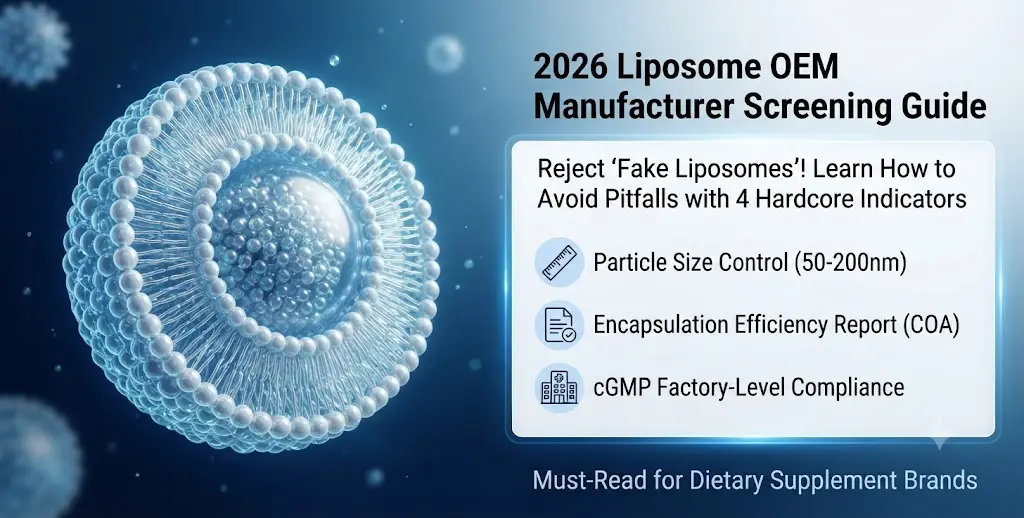
Industry Benchmark: High-quality liposome supplements typically require an encapsulation efficiency of 80%-90%. If a manufacturer cannot provide a Certificate of Accreditation (COA) from a third-party laboratory, its product is highly likely just a mechanical mixture of ordinary raw materials and phospholipids.
2. Particle Size Control and Polydispersity Index (PDI)
The size of liposome particles directly determines their absorption efficiency in the intestines.
Optimal Particle Size Range: 50-200 nanometers (nm). Nanoparticles within this range can be directly absorbed through endocytosis.
PDI (Polydispersity Index): A key indicator for assessing particle uniformity. The lower the PDI (generally recommended to be less than 0.3), the more uniform the size of the liposomes, the more stable the solution, and the less likely it is to separate or aggregate.
Phospholipid Sources and Purity
The main structure of liposomes is composed of phospholipids. Just as a high-quality foundation is essential for a sturdy building, the raw material supply chain of contract manufacturers is crucial:
Phospholipid Type: Prioritize raw materials containing high-purity phosphatidylcholine (PC).
Source: With the global consumer preference for Clean Label products, phospholipids derived from non-GMO sunflowers are more popular than traditional non-allergenic soybean phospholipids and are less likely to cause allergies, helping your brand mitigate potential compliance risks.
Mass Production and Process Control Capabilities (CMC Specification)
Making a small, perfect cup of liposomes in the lab isn't difficult; the challenge lies in commercial scale-up production. Liposomes are extremely sensitive to shear forces, pressures, temperatures, and pH levels during the production process.
When selecting a manufacturer, it's crucial to thoroughly examine their industrial equipment and processes:
【The Correct Process Path for Liposome Mass Production】
Assessing Technical Feasibility -> Optimizing the Physicochemical Formulation -> Pilot Batch Production -> Commercial Mass Production
An excellent contract manufacturer should possess the following key strengths:
Advanced Production Equipment: Does the manufacturer have advanced preparation equipment such as high-pressure homogenization or microfluidics? This is crucial for ensuring uniform particle size.
Stability Testing Capabilities: Can the manufacturer provide long-term and accelerated stability test data (including the effects of temperature, light, and pH on liposome membrane integrity) to ensure your product won't experience leakage or breakage during its 24-month shelf life.
Compliance and Certification
Required Compliance Certification: GMP or ISO 22000 (Food Safety Management System) certification is mandatory.
Transparent System: A reliable manufacturer should be able to readily provide batch records and detailed Certificates of Analysis (COAs) for each batch.