Phone: +86 18966915318
E-mail: sales05@nutritionoem.com
Add: Room 815, Unit 1, Building 1, Zhongjian Caizhi Plaza, Mingguang Road, Yuanding Road, Economic And Technological Development Zone, Xi'an, Shaanxi, China
Liposome encapsulation technology vs. traditional capsules
What is Traditional Capsule Delivery?
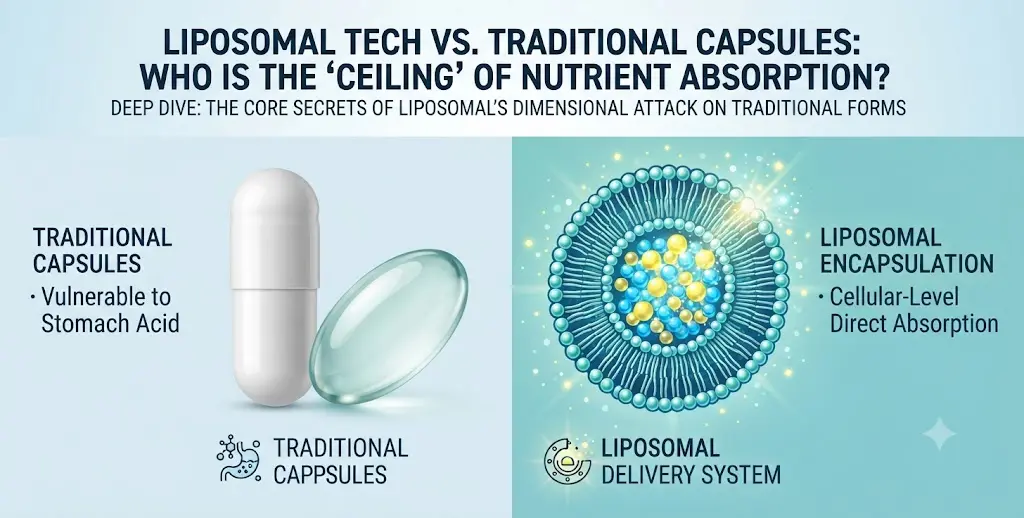
Traditional capsules—including hard-shell gelatin, Hydroxypropyl Methylcellulose (HPMC/vegetable), and softgel configurations—are designed to encapsulate solid powders, granules, or liquid formulations.
How It Works
-
Ingestion & Disintegration: The digestive tract ingests the capsule shell. Gastric acid (pH 1.5–3.5) and stomach enzymes dissolve the outer shell within 10 to 30 minutes.
-
Release & Dissolution: The raw ingredient powder is released into the gastric fluid, where it must dissolve completely into solution.
-
Passive Absorption: Dissolved active molecules move into the small intestine, relying primarily on passive diffusion or specific protein transporters to cross the intestinal epithelium (enterocytes).
Key Limitations
-
Gastric Degradation: Acid-sensitive compounds (such as Vitamin C, Glutathione, and Probiotics) can be denatured or oxidized before reaching the small intestine.
-
Low Solubility & Large Molecular Size: Hydrophobic (fat-soluble) molecules like Curcumin, CoQ10, or Resveratrol form large molecular aggregates in water, making it difficult for the intestinal mucosa to absorb them.
-
First-Pass Hepatic Metabolism: Once absorbed into the portal vein, ingredients head directly to the liver, where hepatic enzymes breakdown a significant percentage before the compounds reach systemic circulation.
What is Liposome Encapsulation Technology?
Liposomal technology originates from target-driven pharmaceutical drug delivery systems. A liposome is a microscopic, spherical vesicle composed of a double layer of phospholipids—the exact same structural building blocks that form human cell membranes.
The Bilayer Architecture
-
Hydrophilic (Water-Loving) Core: Traps water-soluble compounds like Vitamin C, B-Vitamins, or Peptide chains inside the sphere.
-
Lipophilic (Fat-Loving) Membrane: Encapsulates oil-soluble nutrients like Vitamin D3, K2, Curcumin, or CoQ10 within the lipid wall itself.
The Absorption Mechanism
Liposomes do not rely on standard digestive transport channels. Because their outer layer consists of phosphatidylcholine (derived from non-GMO sunflower or soy lecithin), the body recognizes liposomes as natural biological structures.
-
Gastric Shielding: The durable phospholipid membrane shields the enclosed payload from destruction by stomach acid, bile salts, and digestive enzymes.
-
Direct Cellular Fusion: Upon reaching the small intestine, liposomes can fuse directly with the lipid membranes of intestinal epithelial cells.
-
Lymphatic System Uptake: Liposomes are frequently absorbed via the chylomicron pathway into the lymphatic system, bypassing first-pass liver metabolism and delivering active compounds intact into the main bloodstream.
Direct Technical Comparison
To evaluate performance across key pharmacological parameters:
| Feature / Metric | Traditional Capsules | Liposomal Encapsulation |
| Primary Delivery Mechanism | Disintegation → Dissolution → Passive Epithelial Diffusion | Vesicular Encapsulation → Direct Cell Fusion / Lymphatic Uptake |
| Gastric Protection | Low to Moderate (Requires enteric coatings to survive acid) | High (Phospholipid bilayer acts as a natural protective barrier) |
| Systemic Bioavailability | Low to Moderate (10%–20% average for difficult compounds) | High to Superior (Up to 80%–90%+ relative absorption) |
| First-Pass Liver Clearance | High (Passes directly through the hepatic portal system) | Low (Bypasses initial liver degradation via lymphatic transport) |
| Cellular Uptake Rate | Dependent on active transport proteins and osmotic gradients | High (Fuses with cell membranes via structural mimicry) |
| Gastrointestinal Side Effects | High potential for irritation (e.g., concentrated Iron or Vitamin C) | Low (Phospholipid wall protects gastric mucosa from direct contact) |
| Ingredient Degradation Rate | High susceptibility to moisture, heat, and enzymatic degradation | Low oxidation risk when stabilized correctly |
| Manufacturing Complexity | Standard (High throughput, lower production cost) | Advanced (Microfluidization/Sonication, strict quality controls) |
Why Molecular Delivery Matters
The biological effectiveness of any supplement is ultimately determined by its AUC (Area Under the Curve)—the total concentration of an active compound in blood plasma over time.
Active botanicals like Curcumin are naturally hydrophobic. When delivered via a standard capsule, curcumin molecules clump together, creating large agglomerates that cannot cross the intestinal wall's mucosal layer. Most of the ingested dose passes unabsorbed through the gastrointestinal tract.
Liposomal processing integrates curcumin directly into the phospholipid membrane at a sub-micron scale (typically 100–200 nanometers), enabling complete dispersion in aqueous environments and immediate cellular uptake.
Nutrients like Reduced Glutathione (GSH) contain fragile peptide bonds that oxidize quickly when exposed to stomach acid. In conventional capsule formats, oral oral glutathione supplementation yields minimal increase in systemic tissue levels.
Liposomes completely isolate the glutathione molecule within an aqueous core, preventing degradation by digestive enzymes like $\gamma$-glutamyltransferase. Clinical trials demonstrate that liposomal glutathione elevates plasma and cellular glutathione reserves significantly faster than unencapsulated formats.
When to Choose Which Delivery System
-
Fragile, Acid-Sensitive Compounds: Glutathione, Vitamin C, NAD+ precursors (NMN/NR), B12.
-
Hydrophobic / Fat-Soluble Botanical Extracts: Curcumin, CoQ10, Resveratrol, Quercetin, CBD.
-
High-Dose Nutrients That Cause GI Distress: High-dose Vitamin C or Iron formulations that trigger stomach pain or diarrhea in standard powder formats.
-
Targeted Therapeutic Results: Situations requiring rapid plasma concentration and high cellular accumulation.
-
Stable Nutrients: Minerals like Zinc Picolinate or Magnesium Glycinate that possess high inherent stability and good intestinal uptake mechanisms.
-
Bulky Macro-Nutrients: Ingredients requiring high gram-level dosing (e.g., Creatine, Amino Acids, Fiber), where lipid encapsulation would require an impractically large liquid or capsule volume.
-
Cost-Sensitive Core Formulas: Daily multivitamins intended for basic nutritional maintenance where extreme bioavailability boosts are not strictly required.
Which Nutrients Most Need Liposome Upgrades?
Not all ingredients require liposome technology, but for the following star ingredients with poor stability and extremely difficult absorption, liposome technology has brought revolutionary changes:
Vitamin C (Liposomal Vitamin C): Oral vitamin C absorption drops drastically after exceeding 1000mg and irritates the stomach. Liposome vitamin C achieves ultra-high absorption without harming the stomach.
Glutathione (Liposomal Glutathione): Traditional oral glutathione is almost completely destroyed by digestive enzymes in the stomach. Only liposome encapsulation can fully protect its antioxidant activity and deliver it directly to cells.
Curcumin (Liposomal Curcumin): Curcumin is notoriously "fat-soluble, poorly absorbed, and rapidly metabolized." Liposomes increase its bioavailability by tens of times.
NMN/Coenzyme Q10: Targeting key cellular-level coenzymes for anti-aging, liposomes ensure precise delivery to mitochondria.
How to Identify Authentic Liposomal Products
Due to the market demand for liposomal supplements, some manufacturers use simple mixtures of unesterified lecithin and nutrient powders, falsely labeling them as "liposomal." True liposomal formulations require advanced processing methods like high-pressure microfluidization to achieve uniform nanoparticle sizing.
When evaluating liposomal supplements, look for these analytical criteria:
-
Particle Size Verification: High-quality liposomes range between 100nm and 200nm in diameter. Particle size analysis (Dynamic Light Scattering / DLS) ensures the liposomes are small enough to pass into circulation intact.
-
Phospholipid Sources: Look for purified phosphatidylcholine (PC) sourced from non-GMO sunflower or soy lecithin, rather than crude lecithin blends.
-
Encapsulation Efficiency (EE%): Top-tier manufacturers state their encapsulation efficiency rate, indicating the exact percentage of active ingredient locked inside the vesicles versus floating freely in the solution.
-
Visual & Structural Integrity: True liquid liposomes are translucent or uniformly opaque suspensions that do not separate into layers or form heavy sediments over time. Dry liposomal powders should utilize liposomal dehydration matrices rather than simple dry-blends.